Potomac-Bethesda First Rotary Club to Donate to Swat Relief Initiative in Pakistan
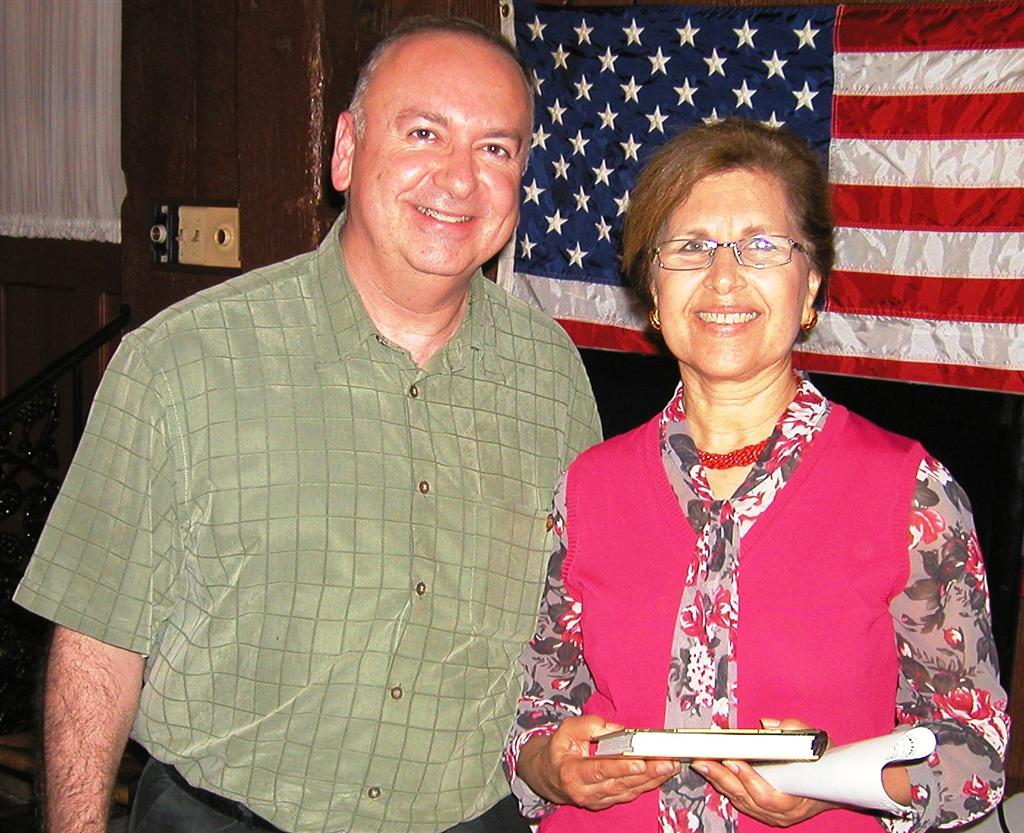
President Nabil Bedewi presents a Rotary Cookbook to Zebu Jilani, Founder of the Swat Relief Initiative and a Rotarian in Swat Valley, Pakistan.
Swat Relief Initiative
Integrative Rural Development Program
Rotary Club of Potomac-Bethesda, MD
August 30, 2012
I would like to thank Doctor Howard for inviting me to speak to you about Swat Relief Initiative’s humanitarian work in the Swat Valley. I am really honored to be here among fellow Rotarians.
I would like to start by giving you a brief background on Swat.
Swat was an independent State, until 1969, with its own Ruler called the Wali. In his book “Lords of the Khyber” Andre Singer notes the extraordinary achievements of the Wali of Swat who took a lawless tribal area, united its warring tribes, and transformed it into an efficient State - with all the machinery of modern government like schools, hospitals, roads and a fair justice system.
Many have called Swat a paradise on earth and a tourist haven. Queen Elizabeth, during a hunting trip in 1961, called it “the Switzerland of the East” because of its stunning landscapes, snow-capped mountains, gushing streams, fruit-laden orchards and its hospitable, peace-loving people.
Unfortunately, the peaceful Swat that many tourists remember is no more. The independent State of Swat was taken over by Pakistan in 1969, ending the rule of the Wali. In the absence of the Wali’s personal dedication and the many social services he provided, there began a decline in infrastructure, education, and the Justice system. Having seen better times, the people of Swat were not happy with the situation, and the Taliban saw it as an opportunity to gain power by promising to restore the Wali’s system of government. People joined them, as they were nostalgic for the old justice system under their benevolent ruler. It was not until the Taliban became a real force in Swat that people realized their hypocrisy. Everyone watched helplessly as the Taliban beheaded thousands of people, banned education for girls, and trained many vulnerable young boys as suicide bombers to destroy police stations, clinics, roads and schools that my grandfather, the Wali, and his father before him had so painstakingly built.
Even under normal circumstances, women in rural Pakistan are the most disadvantaged and vulnerable group in society, but after the implementation of the misogynistic doctrine of the Taliban, women suffered both physically and mentally, and whatever progress they had made was set back hundreds of years.
This is why we created the Swat Relief Initiative to help women and children in this devastated area.
In 2009, the Pakistan Army finally came to get rid of the Taliban in Swat. The ensuing conflict displaced more then two million people from their homes, creating a human disaster unprecedented in Pakistani history. During this time Swat Relief Initiative provided critical healthcare, food, clothes and other supplies to make life bearable for thousands of women and children who were in dire circumstances.
In 2010, Swat Relief Initiative again came to the rescue of women and children during the Mega-flood that devastated lives, homes and infrastructure in Swat.
After three years of major disasters in Swat, we now have thousands of widows and orphans in a society that shuns them, creating mental and physical illnesses at levels unprecedented in that part of the world.
These disasters have also weakened society and the tradition of village leadership organizations called jirgas. Locals have become more insular and feel helpless and disheartened in the face of official corruption while their communities become progressively more dysfunctional. In addition, this problem is compounded by aid that comes mostly in the form of handouts, which are much easier to dispense, than implementing programs that help people become self-sufficient in the long run.
For this reason, Swat Relief Initiative has partnered with Human Development Foundation to implement a long term, sustainable and holistic approach - an Integrative Rural Development Program that will help disadvantaged people maintain their dignity and teach them to become self-reliant. A key feature of this Integrative Program is that it takes into account the needs of each specific community. We feel that, more than anyone else, the local beneficiaries are aware of the kinds of development they need, and they are the most motivated to bring about change.
Our programs, with their holistic approach, deal with all aspects of development, leading to independence and self-reliance for communities that can be functional and bring about positive change.
The main components of this Integrative Rural Development Program are:
1. Social mobilization and development of democratic processes at the grassroots level
2. Health
3. Education
4. Economic development, and,
5. A sustainable environment
Social Mobilization
The basis of all our programs is the Social mobilization component; and let me explain what Social Mobilization means for communities without hope. Social mobilization is the means through which we help communities become organized through a democratic process, so they can identify key problems they are facing and work together as a group to solve those problems. I should emphasize that none of our programs can be long lasting or sustainable without the involvement of the community that we serve.
One of our biggest accomplishments has been to organize all the community minded people in the society under the banner of Rotary to maximize our impact. Initiating the Rotary Club has helped empower well-meaning folks in the community to help their own people in a coordinated way, and put them in touch with millions of Rotarians all over the world. Swat Relief Initiative and The Rotary club in Swat now work in partnership to help eradicate polio. Last year alone, 97 new cases of Polio were reported in Pakistan, which has the highest incidence of Polio in the world, of the 97 cases 70 were reported amongst the Pashtoon ethnic group who’s healthcare needs Swat Relief Initiative serves, and actively vaccinates to eradicate polio. Other projects that Swat Relief Initiative has implemented with the help of Rotary in Swat are:
1. Funded an Electrophoresis machine for thalassemia patients at the Al-Fajar Foundation.
2. Bought computers for deserving students.
3. Got new equipment for the Maternity Ward, Central Hospital, worth 20,000 dollars.
4. Collected donations to hire two doctors and two cleaners to improve health and hygiene for poor women in the Maternity Ward in Saidu.
5. Organized and arranged for a mobile prosthesis clinic to come to Swat to treat scores of people who have lost limbs.
6. Created a movement called Green Swat, which works with the environment minister to plant trees in Swat. So far we have committed to planting 200,000 trees.
7. Brought in a geologist from the United States to look at the possibility of mineral exploration in Swat.
8. The Rotary Club of Swat is the only organization that had the audacity to host the first public musical event after the Taliban takeover in 2009.
9. Installed a water filtration plant in an SRI target village to provide clean drinking water for thousands of villagers for the first time.
Other activities in our Social Mobilization Program include:
1. Formation of Village Development Organizations
2. Identification and prioritization of key problems facing the community
3. Helping the community form and implement a Village Development Plan
4. Creating and strengthening democratic process at the grassroots level
Social Mobilization, the key component of our development initiative, helps make our programs cost-effective and sustainable because it mobilizes the community to work along with us. We have found, that this is the only way to succeed in the long term.
Health
Our Preventive Healthcare program is active in 8 villages and covers a population of more than 16,000 people. Our target groups are women and children who are the most vulnerable in this male dominated society.
The World Health Organization cites malnutrition as the single gravest threat to the world's public health. Improving nutrition is now regarded as the most effective form of aid, because when people are malnourished their productivity and quality of life are greatly diminished, putting them at risk for mental and physical illnesses. According to the WHO, malnutrition is the biggest contributor to child and maternal death, and according to the Lancet Medical Journal, the effects of malnutrition in the first two years of life are irreversible, as malnourished children grow up with worse health and a higher incidence of mental illness, and their own children also tend to be smaller and die younger.
Because of these findings, our Preventive healthcare program concentrates on improving the health and nutrition of women and children who are at risk.
Most women in Swat do not have access to a doctor due to social constraints. There is a pushto proverb which goes: “The khazay the para yah kor dai ya gor dai” which means that “For a woman there is either the house or the grave”. Our healthcare program is very effective because we take these social constraints into consideration and have a system of trained Lady Health Workers who provide healthcare to these women in their homes.
Here is an example. This is baby Gulsanga. You can see her compromised condition from this photograph. She had multiple problems - was extremely underweight, very anemic and always sick. Her mother, a widow, who was suffering from depression and severe anemia, did not have the means to take her to a doctor. After we treated Gulsanga, she regained her health and is a vibrant toddler. Not only that, but her mother and sister who were very anemic and suffering from depression also regained their health. Were it not for our health program baby Gulsanga would have had a very slim chance of survival.
The main goals of our health program are
1. Reducing infant mortality
2. Improving maternal health, and,
3. Reducing the incidence of major diseases
We achieve these goals by
1. Monitoring pregnant and lactating mothers
2. Growth monitoring of children to detect malnutrition
3. Referring malnourished and underweight children to doctors
4. Vaccinating mothers and children to prevent major diseases
5. Conducting Health and Nutrition Seminars, and,
6. Health Camps to prevent malnutrition - a major cause of physical and mental illnesses.
Economic Development
The United Nations Development Program states that equality andempowerment for women starts with economic independence. Loss of life due to the Taliban conflict and massive floods have created thousands of widows, who have no means of support.
For this reason we have started a Vocational Training Center for women to teach them skills that will help them become independent and earn a living with dignity, so they can support their families.
This is a picture of Sheereena with her four daughters. Sheereena’s husband died in a bomb attack by the Taliban. At the time she was expecting her youngest and fourth daughter. Having daughters and no male child put her in a category in pukhtoon culture called Mirath. Mirath is one of the worst curses in Pashto. Being Mirath for Sheereena meant that since she did not have a male child, her husband’s property was inherited by his brothers, and she was at their mercy. When I met Sheereena, she was destitute, suffering from depression and was a nonentity in her male dominated society; all because she was unfortunate to have just daughters, in a society that only values male children.
Sheereena is now in our Vocational Training Center, were she is learning to provide for her family, getting psychological and moral support, and is part of a women’s group where she can identify her problems and solve them with others in the same situation. Unlike Sheereena, her daughters will get an education with a scholarship we have provided, and have access to our preventive healthcare so that they will be less likely to suffer from mental and physical illnesses.
Our activities in Economic Development are:
1. Forming Vocational Training Centers for Women
2. Training for Women in traditional Swati embroidery, dress making and knitting
3. Developing better access to the market for products made by women and cutting out the middleman so they get a larger share of the profit
4. Opening of adult literacy centers for women between the ages of 15 and 45
Education
In Swat there is a big gender gap in the areas of education, medical care, nutrition and upbringing. Girls are less likely to be educated than boys. Even if they are sent to primary school, they are less likely to go to high school and even less likely to go to college than their male counterparts. Female children are also less likely to be taken to a hospital to get medical care. During their upbringing, females have a lower status in the household than males. Girls are trained to serve the male members of the family and generally eat leftovers that are less nutritious than what the males of the family eat, putting their health at risk, and making them less likely to succeed in school.
To create gender equality, education for girls is of the utmost importance.
Activities for our education program include:
1. Forming Parent Teacher associations in local schools
2. Teacher training programs to develop critical thinking, confidence and leadership
3. A school curriculum based on civics, good citizenship and volunteerism
4. Seminars and workshops to raise awareness about the importance of education especially for girls
5. Enrollment campaign for children’s education
6. Scholarship program for deserving children
Sustainable Environment
During our survey of these villages, two of the major problems we saw were lack of safe drinking water supplies and no sanitation management of solid waste. Wastewater and solid waste end up in the village streets and are a source of unsanitary living conditions. The situation is exacerbated in the rainy season because poor drainage systems cause streets to be flooded leading to the spread of many waterborne diseases.
We believe that helping communities keep their environment clean saves lives.
Activities to improve the environment include
1. Cleanliness drives in communities
2. Creating access to safe drinking water
3. Construction of community drains and sewage system
4. Installation and extension of water supply as needed by the community
5. Tree planting drives
6. Helping communities create a solid waste management system
I want to emphasize that the programs I have described are implemented with the help of the community making them cost effective, long term and sustainable.
I would like to conclude by saying that Swat Relief Initiative is trying to achieve its goals by helping people help themselves and their communities, with pride and dignity.
All our programs, whether they be our vocational centers for poor widows, our health program for women and children or our educational initiatives, help avoid dependency, create gender equality, lower risk for physical and mental illnesses and empower people to lead independent lives.
Many organizations that conduct programs in that part of the world have a very superficial connection to the reality on the ground. We are some of the few who not only run our programs ourselves but also work at the grass roots level, involved with the locals at every stage of our initiatives. This important element is missing in most programs operating in Swat, creating a disconnect and lack of oversight that has resulted in many problems.
Swat Relief Initiative’s Integrative Rural Development Program aims to make communities healthier and more functional so they can better serve the people. With the knowledge and power of collective problem-solving, people in these rural villages can be involved in their own development and can also become watchdogs for their institutions so they can hold their leaders accountable. This development program also provides a functional democratic process at the grassroots level.
Dissatisfaction with the lack of social services created an opportunity for the Taliban to convince the population that their ideology was the only solution. It is imperative that the population be made aware of alternatives, like our Integrative Rural Development Program, which empowers people and brings about positive change in their societies in a democratic way. In addition to spurring development, this awareness will also make communities stronger and less vulnerable to extremist takeovers.
Swat Relief Initiative’s organizational staff is an all-volunteer force that pledges 100% of all donations will go directly to helping improve the lives of the poor in Pakistan. By eliminating waste and corruption, the founding members strive to pay any overhead from their personal funds.
In the last few years I have felt great anguish and sadness, while witnessing the land that I love, destroyed by two consecutive disasters. I remember vividly how hard my grandfather worked to make Swat into the idyllic place it once was. The only way I know how to honor him is to make a commitment to carry on the work he started, in the hope of bringing Swat back to its former state of tranquility.
I want to ask my fellow Rotarians to think about how we can work together in a meaningful way to help these desperate people help themselves. My thought is, that if we can provide security in the form of jobs and services, we will be able to give these people their only chance to defeat the Taliban and take back control of their beautiful Swat valley.